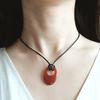
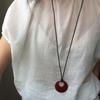
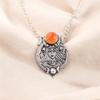
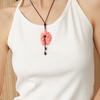
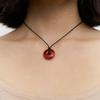
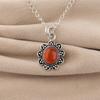
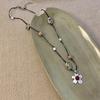
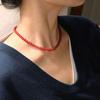
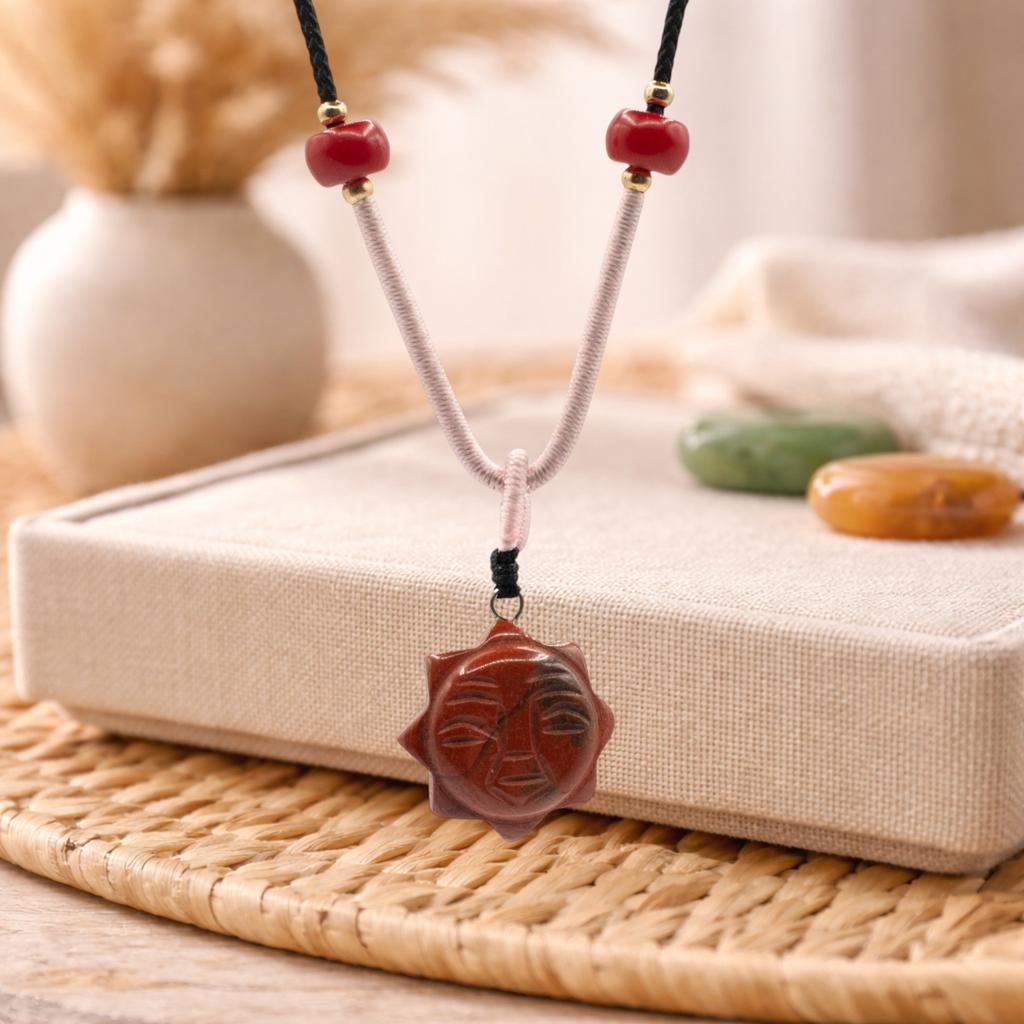
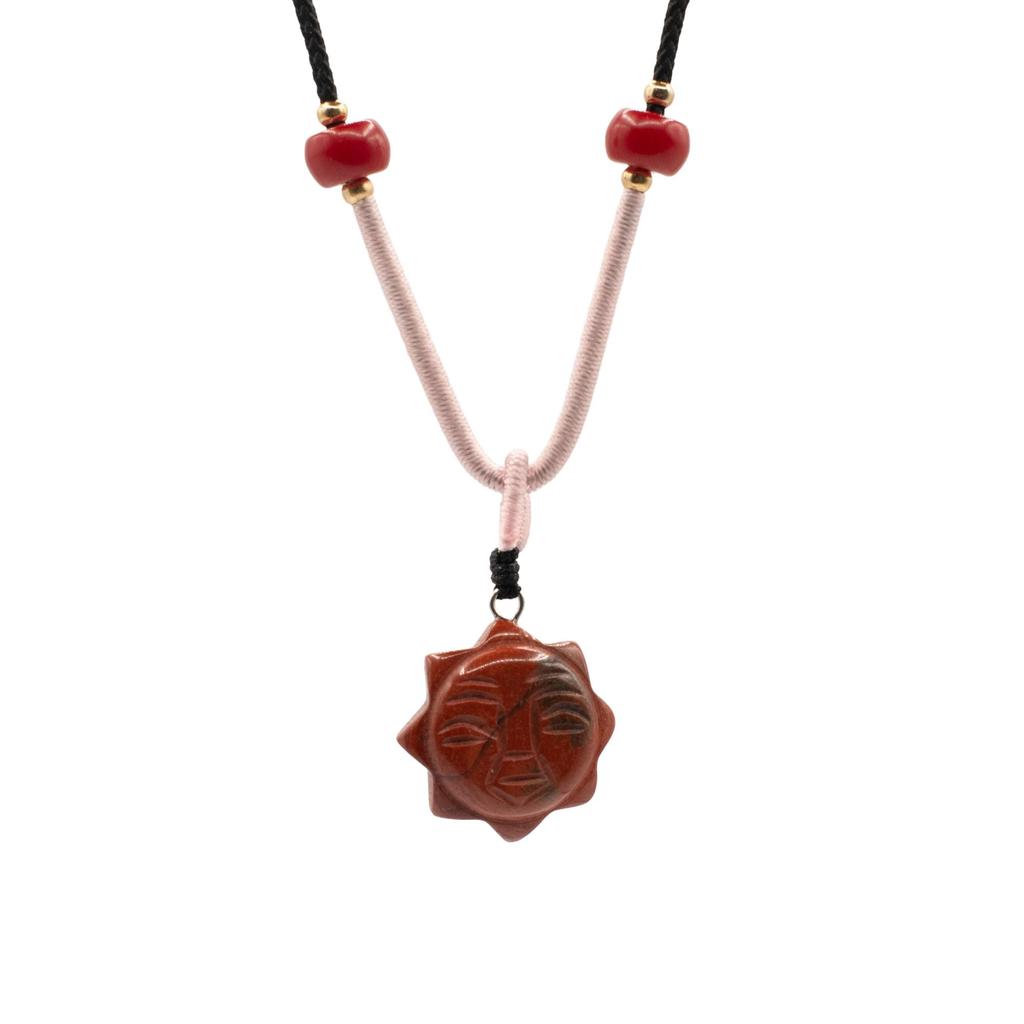
A sun face pendant carved from carnelian on an adjustable cord necklace. The stone is a warm, translucent orange — somewhere between burnt honey and ripe apricot — with depth and glow rather than flat, opaque colour. When light passes through it, carnelian comes alive: it has an internal warmth that makes it look almost lit from within. The sun face is carved in a traditional style — a round disc with simplified facial features surrounded by radiating rays. It is the most energetically warm piece in the range: warm stone, warm colour, warm symbol.
What You'll Notice First
Carnelian's translucency means light passes into the stone, giving it an inner glow that flat, opaque stones cannot produce. The orange shifts from pale honey to deep reddish-brown depending on the piece.
The sun face has more surface detail than simpler shapes in the range — carved facial features and ray projections create small shadows and highlights that give the piece visual movement as the wearer moves.
Most carnelian on the market has been heat-treated to deepen the colour — an ancient practice (the Egyptians did it) considered standard in the gemstone trade. The heat intensifies what is naturally there by further oxidising the iron content.
Mohs hardness: 6.5 to 7. One of the more durable stones in the range. Total weight: around 5 grams. Adjustable cord necklace.
One of the Oldest Decorative Stones
Carnelian is a variety of chalcedony coloured orange-to-red by iron oxide. It was among the first minerals used for jewellery — carved beads and seals have been found at sites dating to the 5th millennium BCE across the Indus Valley, Mesopotamia, and Egypt. It appears in the funerary jewellery of multiple pharaohs, including pieces from Tutankhamun's tomb. The Egyptians associated it with the setting sun and with the goddess Isis. Roman soldiers wore carnelian signet rings, and Islamic tradition records that the Prophet Muhammad wore a carnelian ring.
The Sun Face
Sun face imagery appears in virtually every culture that has left a visual record — Aztec, Hindu, Greek, Inca, Japanese, Egyptian. The sun-as-face is one of the oldest and most universal symbols humans have produced. On carnelian, the pairing is unusually well-matched: the stone's warm orange glow literally looks like captured sunlight, and the carved solar imagery reinforces that impression. The Egyptians made this same connection thousands of years ago. It is one of those combinations where material and form tell the same story independently and amplify each other together.
Size and Details
Pendant: real carnelian (chalcedony), sun face shape, approximately 2.5 × 2.5 × 3 cm. Adjustable cord necklace. Total weight: approximately 5 g. Origin: China. The most detailed carving in the range — the facial features and radiating rays require more skilled stone-cutting than simpler geometric shapes.
In the Crystal Tradition
Carnelian is associated with the sacral chakra and linked to creativity, confidence, courage, motivation, and action. It is often described as the stone you reach for when you need to stop hesitating and start doing. Historical traditions support this: Egyptian warriors carried carnelian for courage in battle. Combined with the sun's vitality symbolism, this is the "get up and go" pendant — the opposite of the calming, reflective energy of howlite or amethyst.
Gift-Ready
A gift that communicates warmth, positivity, and encouragement. The sun face reads as cheerful and optimistic. Good for people who need a boost of confidence, for creative types, for summer birthdays, and for anyone starting something new that requires courage and energy. The warm orange tone is gender-neutral and age-neutral. Among the range's strongest gift options — where the heart says "love" and the clover says "luck," the sun face says "energy" and "joy."
Common Questions
Has this carnelian been heat-treated?
Most commercial carnelian has been heat-treated to deepen and even out the orange colour. This is an ancient, standard practice that intensifies the stone's natural iron-based colour without adding anything artificial.
Why does the orange colour vary between pieces?
The shade depends on iron concentration and oxidation state within the stone. Lower iron produces paler, yellowish orange; higher iron pushes the colour towards deeper reddish-brown. Each piece is natural and unique.
Is the sun face carving detailed enough to see clearly?
Yes. The facial features and radiating rays are clearly defined and add visual depth. It is the most intricately carved pendant in the range.


 Rückerstattung bei Nichtlieferung