• General purpose
• Material: Stainless steel
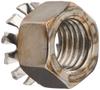
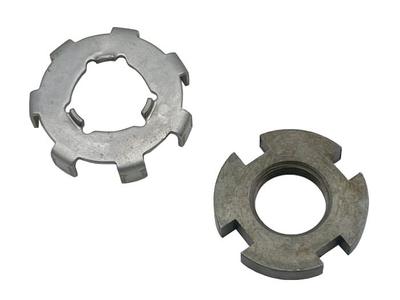
Static elimination nut M10 P1.25 Single item Stainless steel
Improve engine performance and suspension performance!Antistatic bolt and nut that can eliminate static electricity
A considerable amount of static electricity accumulates in various parts of automobiles and motorcycles while they are running.
The negative effects of static electricity are greater than you think, and can worsen engine performance, suspension performance, and even aerodynamics.
These bolts and nuts restore their original performance by discharging and eliminating static electricity.
You can experience the effects by simply replacing the bolts on your vehicle or installing an additional nut on the protruding part of the bolt.
Negative effects of static electricity
Static electricity is caused by the friction between two types of materials.
This can occur with friction between solids, liquids, and gases, and static electricity is generated everywhere in cars and motorcycles, such as friction between the body and the air when the vehicle is running, friction from the rotation of the engine, friction from the movement of the suspension, and friction between the tires and the road surface.
This static electricity can cause problems with the flow of materials.
- Separation from the body and air flow.
- Oil, fuel, grease, rubber, etc. harden (change in viscosity) due to static electricity.
These factors can result in, for example, a lack of aerodynamic stability, decreased response due to poor intake air and fuel flow, and increased friction due to hardening of engine oil and suspension oil.
Below is the explanation of Toyota's patent that has been published.
[Excerpt from JP 2016-124319]
An object of the present invention is to provide a vehicle that can suppress positively charged airflow from separating from the outer surface of a vehicle body at an unintended position due to the vehicle body being charged with positive static electricity.
[0014] Since the static electricity charged on the surface of the vehicle body can be reduced and the positive potential can be lowered, the repulsive force (repulsive force) generated between the vehicle body and the positively charged airflow can be reduced.
Therefore, separation of positively charged airflow from near the surface of the vehicle body can be suppressed.
As a result, it is possible to prevent the air pressure acting on the surface of the vehicle from changing beyond expectations and the resulting deterioration of the aerodynamic characteristics of the vehicle, thereby preventing a decline in driving performance such as steering stability.
[0015] By suppressing separation of airflow at high positions in the vehicle height direction, it is possible to efficiently suppress changes or deterioration of aerodynamic characteristics, particularly in the rolling direction or pitching direction of the vehicle body.
[Excerpt from JP 2016-133032]
An object of the present invention is to improve the operational responsiveness of an engine by eliminating static electricity from lubricating oil or fuel.
[Solution] A strainer (2) for lubricating oil or fuel is placed at the bottom of a tank (1) storing lubricating oil or fuel, and the tank (1) and the lubricating oil or fuel (4) stored in tank (1) are positively charged.
A self-discharge static eliminator (10) is installed on the outer surface (8) of the bottom wall of the tank (1), which is behind the inner surface (7) of the bottom wall of the tank (1) facing the strainer (2), and this self-discharge static eliminator (10) eliminates static electricity from the lubricating oil or fuel (4) flowing into the strainer (2).
When the self-discharge static eliminator 10 is installed on the outer surface of the pump 3, the lubricating oil or fuel flowing inside the pump 3 is static-eliminated.
Therefore, in this case as well, the viscosity of the lubricating oil or fuel decreases, and as a result, the lubricating oil or fuel can be supplied to the required locations with good response during engine operation, improving the operational responsiveness of the engine.
Toyota adopts static electricity removal in mass-produced cars
Toyota Motor Corporation has conducted tests to prove the negative effects of static electricity and the effectiveness of eliminating static electricity.
This technology is also used in Toyota's mass-produced cars.
The photo on the right is an aluminum tape that actually has a genuine Toyota part number.
This tape discharges static electricity.
It is actually affixed to mass-produced commercial vehicles.
Eliminate static electricity
One way to eliminate static electricity is to discharge it from metal with sharp edges.
These static elimination bolts and static elimination nuts are shaped to have more sharp points, and the tips of the jagged parts are also polished to further enhance the discharge effect.
Eliminating static in the suspension section provides a supple ride.
Eliminating static from the fuel gauge and intake air system can improve engine response and fuel efficiency.
The static elimination bolt is used in place of the existing bolt.
The neutralization nut can be attached to the protruding part of an existing bolt or by replacing the nut itself.
Precautions during installation
- The crown part is sharp, so please handle with care to avoid injury.
・Due to space issues, it may not be possible to install the static eliminating bolt or nut.
Please check the space at the installation location in advance.
・The static elimination bolt has a static elimination nut welded onto the cap bottle.
When installing, use a hex wrench to tighten the bolts, not the nuts.
-The static neutralization effect may vary greatly depending on the part of the vehicle.
Attachment to suspension system
By attaching it to the front and rear of the suspension and the stabilizer part, the suspension system is neutralized, and the suspension moves smoothly by optimizing the viscosity of the damper oil, preventing hardening of the rubber pusher, and preventing hardening of the grease in each part.
Improved ride comfort and operability can be achieved.
Intake, installation to fuel system
By installing it in the intake system or fuel system, you can improve response by reducing intake air resistance, improve response by improving fuel flow, and improve fuel efficiency.